
Forensic Medicine & Toxicology · 4 min read
Organophosphate Poisoning: Mechanism, Clinical Features and Management
Organophosphate poisoning is the single highest-yield toxicology topic in an Indian MBBS exam, and it is also the one students most often answer badly — usually because they memorise a mnemonic without understanding that the patient dies from their airway, not from their pupils.
At a glance
| Agents | Malathion, parathion, dichlorvos, chlorpyrifos, monocrotophos |
|---|---|
| Mechanism | Irreversible inhibition of acetylcholinesterase → acetylcholine accumulates at muscarinic, nicotinic and central synapses |
| Kills by | Respiratory failure — bronchorrhoea, bronchospasm, respiratory muscle paralysis, central depression |
| Antidotes | Atropine (symptomatic) + pralidoxime (reactivates the enzyme, only before ageing) |
| Smell | Kerosene or garlic-like, from the solvent rather than the compound |
Mechanism
Organophosphates phosphorylate the serine residue at the active site of acetylcholinesterase. The enzyme can no longer break down acetylcholine, so acetylcholine piles up wherever it is released.
The critical concept is ageing. Over hours to days, the phosphorylated enzyme loses an alkyl group and the bond becomes permanent. Before ageing, an oxime can prise the organophosphate off and restore function. After ageing, it cannot, and recovery waits for the body to synthesise new enzyme over weeks. This is the entire reason pralidoxime is time-critical while atropine is not.
Clinical features
Muscarinic — DUMBELS
Diarrhoea, Urination, Miosis, Bronchorrhoea and Bronchospasm and Bradycardia, Emesis, Lacrimation, Salivation. The three Bs are what kill; the rest are what you notice first.
Nicotinic
Muscle fasciculations, weakness, tachycardia, hypertension, mydriasis. Nicotinic and muscarinic effects oppose each other on heart rate and pupil size, which is why a poisoned patient can present with a normal pulse and mid-sized pupils. Do not exclude the diagnosis on that basis.
Central
Anxiety, confusion, seizures, coma, central respiratory depression.
The two delayed syndromes
Intermediate syndrome appears 24 to 96 hours after exposure, once the cholinergic crisis has settled. It causes proximal limb, neck flexor and respiratory muscle weakness. Patients who look like they are improving stop breathing. There is no antidote — the treatment is ventilation until it resolves over one to three weeks.
Organophosphate-induced delayed polyneuropathy (OPIDN) appears two to three weeks later as a distal, predominantly motor sensorimotor neuropathy from inhibition of neuropathy target esterase. It is unrelated to cholinesterase inhibition and does not respond to atropine or oximes.
Diagnosis
Clinical, and treatment must not wait for a laboratory result. Confirmation comes from cholinesterase assay: plasma (pseudo)cholinesterase falls earlier and is more widely available; red cell acetylcholinesterase correlates better with synaptic enzyme activity and with severity.
Management
- Protect yourself. Gloves, apron, good ventilation. Staff have been poisoned by contaminated vomit and clothing.
- Airway and breathing first. Suction, high-flow oxygen, intubate early if secretions or weakness are winning. Avoid succinylcholine — it is metabolised by the enzyme the poison has just knocked out, so paralysis is prolonged.
- Decontaminate. Remove all clothing, wash skin and hair with soap and water.
- Atropine. Give a bolus and double it every few minutes until the endpoint is reached. Titrate to a clear chest and dry axillae, not to pupil size. Practical endpoints: chest clear on auscultation, heart rate above 80, systolic BP above 80, dry axillae. Large cumulative doses are normal and expected.
- Pralidoxime. Reactivates acetylcholinesterase if given before ageing, so give it early. It works mainly on nicotinic features — it does not replace atropine.
- Benzodiazepines for seizures and agitation.
- Observe for intermediate syndrome for at least four days, even in patients who look well.
Last-minute checklist
- Ageing is why pralidoxime is urgent and atropine is not.
- Atropine endpoint is a clear chest, never the pupils.
- Death is respiratory in nearly every case.
- Intermediate syndrome hits at 24–96 hours; OPIDN at 2–3 weeks.
- Avoid succinylcholine.
Frequently asked questions
Why are the pupils not always constricted in organophosphate poisoning?
Because nicotinic stimulation causes mydriasis and opposes the muscarinic miosis. The balance between the two varies with the compound, the dose and the time since exposure, so pupil size is an unreliable single sign.
Why is atropine not titrated against pupil size?
Pupils respond to systemic atropine slowly and unpredictably, and chasing dilated pupils leads to gross overdose. Secretions and chest findings track the clinically dangerous effects, so they are the correct endpoint.
What is the difference between intermediate syndrome and OPIDN?
Intermediate syndrome is proximal and respiratory weakness at 24–96 hours from persistent neuromuscular junction dysfunction. OPIDN is a distal neuropathy at 2–3 weeks from inhibition of a different enzyme entirely, and it does not respond to antidotes.
References
- Reddy KSN, Murty OP. The Essentials of Forensic Medicine and Toxicology.
- Goodman & Gilman’s The Pharmacological Basis of Therapeutics — anticholinesterase agents.
- Current national poisoning management protocols for your institution.
Your clinical note. Add what you have actually seen or been taught about this topic — a case from your posting, the way your examiner phrased it, the mnemonic your unit uses. This paragraph is what makes the page yours rather than a summary anyone could write. Delete this box once you have replaced it.
Read next
Forensic Medicine & Toxicology 10 min read
Acute Barbiturate Poisoning: Causes, Symptoms, Diagnosis, and Treatment
Acute barbiturate poisoning is a medical emergency that requires prompt intervention.
Forensic Medicine & Toxicology 4 min read
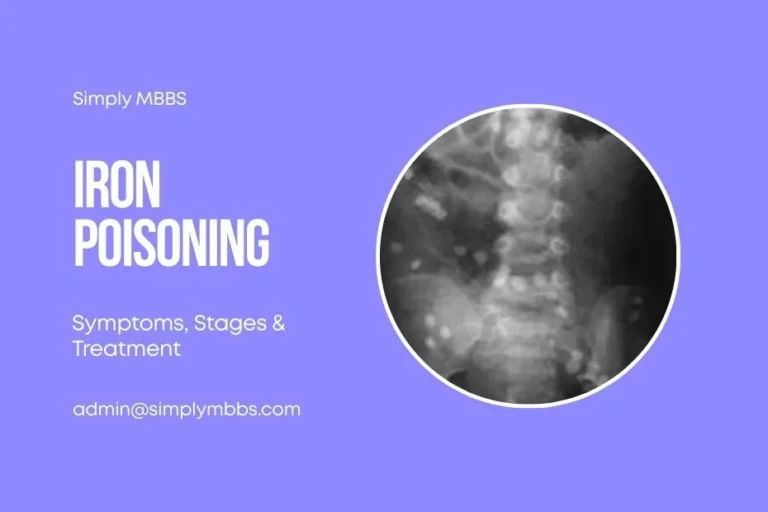
Iron Poisoning Guide – Symptoms, Stages & Treatment
Iron poisoning is a life-threatening medical emergency, especially in children and young adults.
Forensic Medicine & Toxicology 4 min read
Paracetamol Poisoning: Stages, the Rumack-Matthew Nomogram and N-Acetylcysteine
How NAPQI destroys zone 3 hepatocytes, why the patient looks well for the first day, how to actually read the nomogram, and…