
Forensic Medicine & Toxicology · 4 min read
Paracetamol Poisoning: Stages, the Rumack-Matthew Nomogram and N-Acetylcysteine
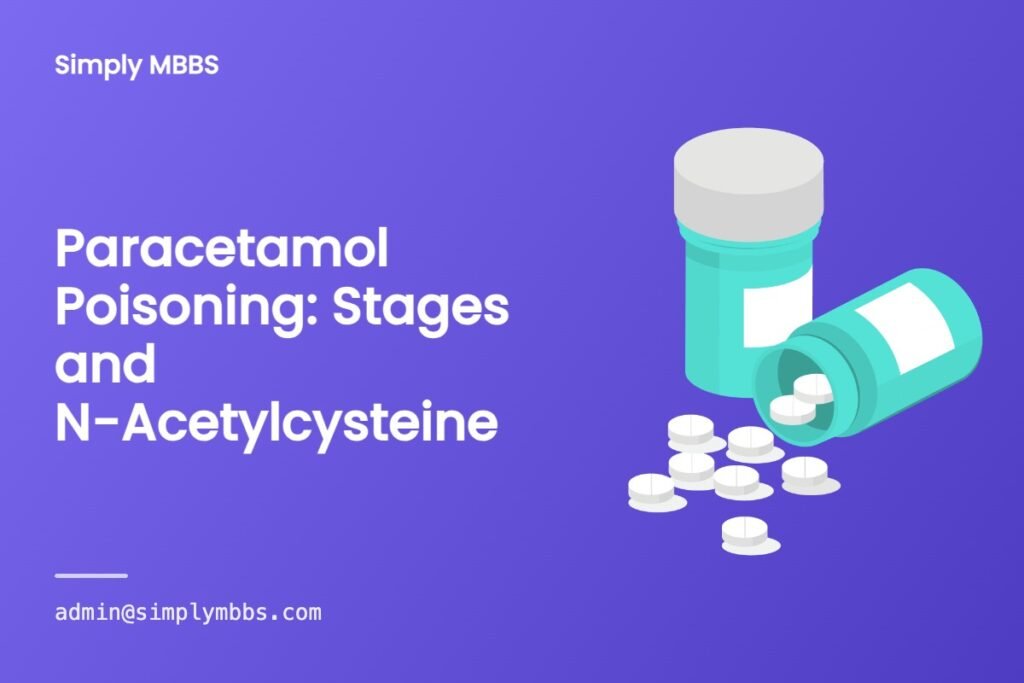
Paracetamol is the most common drug taken in overdose worldwide and one of the few poisonings with a genuinely effective antidote. The examinable trap is that the patient is comfortable and chatty during the window when treatment works best.
At a glance
| Toxic metabolite | NAPQI (N-acetyl-p-benzoquinone imine), produced by CYP2E1 |
|---|---|
| Target | Centrilobular (zone 3) hepatocytes — highest CYP2E1 activity, lowest oxygen tension |
| Toxic dose | Roughly >150 mg/kg, or >12 g, as a single acute ingestion |
| Antidote | N-acetylcysteine — replenishes glutathione |
| Key timing | Nomogram level at 4 hours; NAC most effective within 8 hours |
Mechanism
At therapeutic doses, around 90% of paracetamol is conjugated to harmless glucuronide and sulphate. A small fraction goes through CYP2E1 to NAPQI, which is immediately neutralised by hepatic glutathione.
In overdose the conjugation pathways saturate, more drug is shunted to CYP2E1, and glutathione stores are consumed. Once glutathione falls below roughly 30% of normal, free NAPQI binds covalently to hepatocyte proteins and causes centrilobular necrosis. N-acetylcysteine works by supplying cysteine for glutathione resynthesis, and also by acting as a direct NAPQI scavenger and improving hepatic microcirculation — which is why it still helps in late presentations.
The four clinical stages
| Stage | Time | Findings |
|---|---|---|
| I | 0–24 h | Asymptomatic, or nausea, vomiting, malaise. Liver enzymes normal. |
| II | 24–72 h | Right upper quadrant pain and tenderness, transaminases rising, prothrombin time lengthening |
| III | 72–96 h | Peak hepatic necrosis: jaundice, encephalopathy, coagulopathy, hypoglycaemia, lactic acidosis, acute kidney injury. Deaths occur here. |
| IV | 4 days–2 weeks | Complete recovery of liver architecture in survivors, or progression to transplant |
Using the Rumack-Matthew nomogram
Take a plasma paracetamol level at or after four hours from ingestion and plot it against time. A level below four hours cannot be interpreted because absorption is incomplete.
The nomogram applies only to a single acute ingestion at a known time. It is invalid for staggered overdoses, unknown timing, extended-release preparations, and unreliable in chronic supratherapeutic use — in all of those, treat on clinical grounds rather than trying to force a point onto the graph.
Management
- Activated charcoal if presentation is within about an hour and the airway is safe.
- N-acetylcysteine — intravenous or oral, per your local protocol. Do not delay the first dose waiting for a level if presentation is late or the history suggests a large ingestion; stop it later if the level comes back below the treatment line.
- Anaphylactoid reactions to IV NAC (flushing, urticaria, bronchospasm) are common, are rate-related rather than true allergy, and are managed by slowing or pausing the infusion and giving an antihistamine — not by abandoning the antidote.
- Monitor transaminases, INR, creatinine, glucose, venous pH and lactate.
- Refer to a liver unit early if INR rises, acidosis persists, or encephalopathy appears.
King’s College criteria for transplant referral
In paracetamol-induced acute liver failure, either:
- Arterial pH below 7.3 after adequate fluid resuscitation, or
- All three of: INR above 6.5, creatinine above 3.4 mg/dL, and grade III or IV hepatic encephalopathy.
Last-minute checklist
- NAPQI, made by CYP2E1, neutralised by glutathione, kills zone 3.
- Level at 4 hours, not before.
- NAC works best under 8 hours but is still given late.
- Normal enzymes in the first 24 hours mean nothing.
- Chronic alcohol induces CYP2E1 and depletes glutathione — lower threshold for treatment.
Frequently asked questions
Why is a paracetamol level before four hours useless?
Absorption is still ongoing, so an early level underestimates the eventual peak and can falsely reassure. The nomogram was constructed from four-hour and later values.
Should N-acetylcysteine be withheld if the patient presents after 24 hours?
No. Late NAC still improves outcome in established liver injury through its antioxidant and microcirculatory effects, so it is given even when the classical window has closed.
Why does alcohol change the risk?
Chronic alcohol use induces CYP2E1, pushing more paracetamol down the NAPQI route, and is often accompanied by malnutrition and low glutathione reserve. Both effects lower the dose at which harm occurs.
References
- Goodman & Gilman’s The Pharmacological Basis of Therapeutics.
- Reddy KSN. The Essentials of Forensic Medicine and Toxicology.
- Your hospital’s current N-acetylcysteine protocol — regimens differ between countries.
Your clinical note. Add what you have actually seen or been taught about this topic — a case from your posting, the way your examiner phrased it, the mnemonic your unit uses. This paragraph is what makes the page yours rather than a summary anyone could write. Delete this box once you have replaced it.
Read next
Forensic Medicine & Toxicology 9 min read
Neuroparalytic Snake Bite: Symptoms, Diagnostic Criteria & Treatment Protocol
Snakebite envenomation is a significant yet often overlooked medical emergency worldwide.
Forensic Medicine & Toxicology 3 min read
Datura Poisoning: The Anticholinergic Toxidrome
Atropine, hyoscyamine and scopolamine; the six-part mnemonic; why dry skin separates it from a sympathomimetic; and its forensic role as a stupefying…
Forensic Medicine & Toxicology 4 min read
Carbon Monoxide Poisoning: Why the Pulse Oximeter Lies
Carboxyhaemoglobin, the leftward shift, why cherry-red skin is a bad clinical sign, and when hyperbaric oxygen is justified.