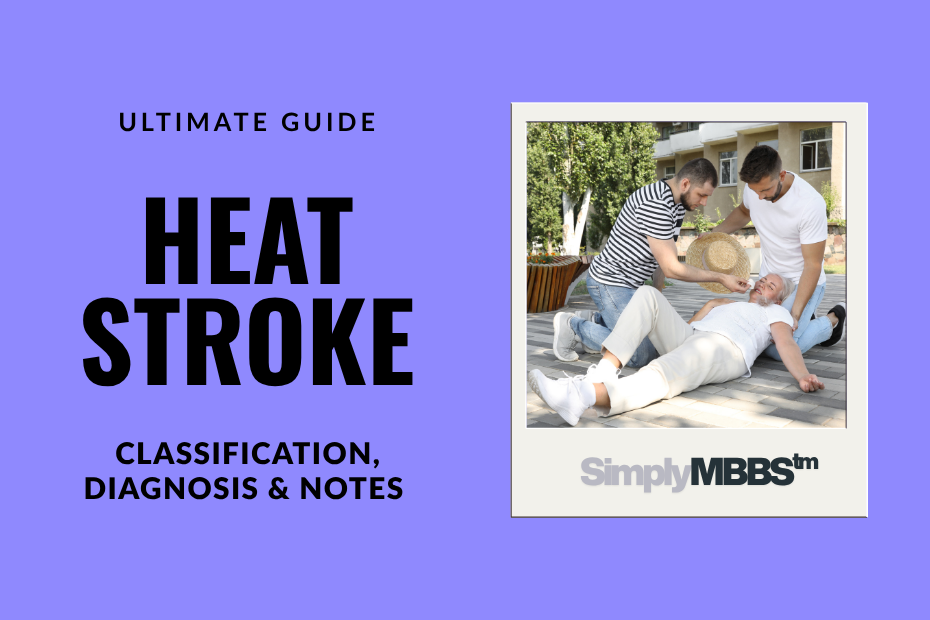
Heat kills more people than any other weather event in many regions, and both the US and India now face longer, hotter seasons. The good news: most tragedies from heat stroke are preventable with fast recognition and cooling. If you are an MBBS student, a junior doctor, a coach, a parent, or an outdoor worker, this guide gives you the essentials—what to watch for, what to do first, and how to keep people safe. You will learn the definition, the differences from heat exhaustion, the step-by-step first aid, ED management priorities, and paediatric precautions. We keep the language clear for the public and exam-ready for students, with tables you can revise from and a university-pattern Q&A at the end.
What Is Heat stroke?
Heat stroke is a life-threatening heat illness marked by very high core temperature (commonly ≥40 °C or 104 °F) plus central nervous system dysfunction (confusion, seizures, coma). Two forms occur:
- Classic (non-exertional): triggered by environmental heat (heatwaves, poor ventilation).
- Exertional: triggered by intense physical activity in heat/humidity (athletes, outdoor workers, military).
Why it’s an emergency: Without immediate active cooling, heat stroke can lead to multiorgan failure and death.
Why Heat stroke Matters
- United States: More frequent heat advisories and warmer nights reduce recovery time between hot days. Communities without adequate cooling access face higher risk.
- India: Prolonged heatwaves, high humidity, and water stress increase risk for infants, older adults, and outdoor workers. Urban “heat islands” and crowded housing intensify exposures.
For both countries, the fastest way to save a life is to recognize red flags early and start cooling immediately—even before transport.
Key Points at a Glance
| Topic | High-yield takeaways |
|---|---|
| Definition | Core temp typically ≥40 °C/104 °F + CNS dysfunction; treat as a medical emergency. |
| Types | Classic (environmental) vs Exertional (activity-related). |
| Immediate goal | **Cool first** — reduce core temp to ≤39 °C as rapidly and safely as possible. |
| Best cooling | Ice-water immersion when feasible; otherwise soak clothing + fan + ice packs (neck, axillae, groin). |
| Red flags | Confusion, agitation, seizures, collapse, hot skin (dry or sweaty), very high temp. |
| Complications | **heat stroke effects** include rhabdomyolysis, AKI, hepatic injury, coagulopathy/DIC, neurologic **heat stroke damage**. |
| Medications to review | Diuretics, anticholinergics, beta-blockers, some antipsychotics; alcohol increases risk of dehydration. |
Read More : Study stamina systems (2-hour rule)
How Heat stroke Happens
- Heat load overwhelms heat loss. Metabolic heat (exercise/work) + environmental heat/humidity exceed capacity to dissipate.
- Sweat/vasodilation plateau. High humidity blocks evaporation; dehydration reduces plasma volume and sweat rate.
- Core temperature surges. Proteins denature; mitochondria fail; gut barrier leaks endotoxin; systemic inflammation accelerates.
- CNS dysfunction. Neuronal injury and cerebral edema cause confusion, ataxia, seizures, coma.
- Multiorgan injury. Rhabdomyolysis → myoglobinuric AKI; hepatic injury; coagulopathy/DIC; dysrhythmias; ARDS.
Heat exhaustion vs Heat stroke
| Feature | Heat exhaustion | **_Heat stroke_** |
|---|---|---|
| Core temp | Often <40 °C | Often ≥40 °C |
| CNS dysfunction | Absent | Present (confusion, seizure, coma) |
| Sweating | Usually profuse | May be absent (classic) or present (exertional) |
| Urgency | Rest, fluids, cooling; observe | **Medical emergency — cool immediately, call EMS** |
Key line: If there is any altered mental status with hyperthermia, treat as heat stroke.
“Heat stroke and stroke” — are they the same?
No. “Stroke” in neurology means cerebrovascular ischemia/hemorrhage. Heat stroke is thermoregulatory failure with hyperthermia and systemic inflammation. Heatwaves can increase vascular stroke risk in populations, but heat stroke itself is not a brain vessel blockage or bleed.
Recognizing Heat stroke: Signs and heat stroke symptoms
- Very high core temperature (if measurable safely).
- Altered mental status: confusion, agitation, ataxia, slurred speech, seizure, coma.
- Skin: hot; may be dry or sweaty.
- Cardiorespiratory: tachycardia, hypotension, hyperventilation.
- GI/Muscle: nausea, vomiting, weakness, collapse.
(Parents: in infants, watch for lethargy, irritability, poor feeding, fewer wet diapers, or unusual sleepiness — see pediatric section below on heat stroke in babies and newborn heat stroke.)
First Aid: What to Do Right Now (field management)
- Call EMS immediately.
- Move to shade or an air-conditioned area; remove outer clothing.
- Cool aggressively while you wait:
- Best: Immerse in cold/ice water (tub, kiddie pool, livestock trough).
- If immersion not possible: Drench clothing with cool water, spray + fan continuously, apply ice packs to neck, axillae, groin.
- If awake and not vomiting: Offer small, frequent sips of water or oral rehydration (supports heat stroke drinking water guidance).
- Monitor airway and responsiveness. Be ready for seizures.
- Avoid antipyretics. Paracetamol/acetaminophen and NSAIDs do not fix hyperthermia from heat stroke.
ED/ Hospital Priorities
- Airway, Breathing, Circulation; consider early intubation if airway is not protected.
- Immediate active cooling to ≤39 °C (target 38–38.5 °C) using cold-water immersion when feasible; otherwise evaporative/convective cooling with mist + fans + ice packs.
- Labs: ABG/VBG, CBC, CMP (Na/K/Cl/HCO₃⁻, creatinine), CK (rhabdomyolysis), LFTs, coags; urinalysis for myoglobin.
- Fluids: Isotonic crystalloids; treat rhabdomyolysis (fluid resuscitation ± urinary alkalinization per protocol).
- Avoid shivering. Use benzodiazepines if needed; avoid antipyretics.
- Complication watch: AKI, hepatic injury, coagulopathy/DIC, electrolyte derangements, seizures, arrhythmias.
- Disposition: Admit; ICU if severe or complicated.
Read More : Anaphylactic emergency recognition
Special Populations: heat stroke in babies and newborn heat stroke
- Risk: Infants have immature thermoregulation and dehydrate quickly; they may not sweat reliably.
- Never leave infants or children in parked cars; even “a minute” is dangerous.
- Home cooling: Light clothing, fans/AC, shade; frequent feeds/breastfeeding.
- Warning signs: Lethargy, excessive sleepiness, irritability, flushed/hot skin, poor feeding, decreased urine output, vomiting, altered responsiveness.
- Action: Move to a cool room, remove extra layers, offer feeds; seek urgent care if any neuro changes, persistent high temperature, or poor feeding continues.
(For students preparing paediatrics viva: list 3 caregiver instructions, 3 red flags, and one transport precaution—cool during transit.)
Heat Stroke Prevention Checklist
- Hydration plan: Drink regularly; don’t wait for thirst. Aim for pale-yellow urine.
- Scheduling: Avoid midday peaks; plan training or outdoor work in cooler hours; rotate tasks.
- Shade & ventilation: Access to cooling centers or shaded rest points; cross-ventilate hot rooms.
- Clothing: Light, loose, breathable fabrics; hats; sunscreen.
- Acclimatization: Gradually increase exposure (7–14 days).
- Buddy system: Check on teammates, workers, neighbors, older adults.
- Medication review: Diuretics, anticholinergics, beta-blockers, stimulants—discuss with a clinician.
- Community readiness: Post clear protocols at worksites and sports facilities.
Common Mistakes to Avoid
- Waiting for a thermometer before acting—treat the patient, not the number.
- Assuming sweating rules out heat stroke (exertional cases may still sweat).
- Using antipyretics instead of active cooling.
- Delaying EMS because “they just need water.”
- Training/working at midday without acclimatization, shade, and scheduled water breaks.
- Leaving infants/children in vehicles “only for a moment.”
The after effects of heat stroke
- Muscle injury & weakness: from rhabdomyolysis.
- Renal issues: acute kidney injury; follow creatinine and urine output.
- Liver dysfunction: transient transaminitis to hepatic injury.
- Neurologic: memory, attention, or coordination problems (possible long-term heat stroke long term effects/heat stroke long term damage).
- Return-to-play/work: gradual, supervised, with hydration, rest breaks, and environmental monitoring.
Read More : Methanol poisoning management
Frequently Asked Questions (FAQs)
Q1. What temperature defines heat stroke?
Often ≥40 °C (104 °F) with altered mental status. Start cooling if you suspect it, even before confirming temperature.
Q2. What’s the fastest way to cool?
Ice-water immersion is fastest. If not available, soak clothing with cool water, spray + fan, and apply ice packs (neck/axillae/groin).
Q3. What’s the difference between heat stroke and exhaustion?
Exhaustion = heavy sweat, weakness, no CNS dysfunction. Heat stroke = high core temp plus neuro signs; it’s an emergency.
Q4. Can I give antipyretics (paracetamol/ibuprofen)?
No. They don’t correct hyperthermia from heat stroke. Use active cooling.
Q5. How much should I drink during heat?
Drink regularly; small, frequent sips during exertion. Add oral rehydration for prolonged activity. Avoid alcohol.
Q6. What are heat stroke in child symptoms?
Irritability, lethargy, vomiting, hot skin, altered behavior, poor feeding. Seek urgent care with any neuro changes.
Exam Question–Answer (University Pattern)
Exam stem (10 marks): “Describe heat stroke under definition, etiology, pathophysiology, clinical features, complications, and management.”
Mark distribution: Definition 1, Etiology 1, Pathophysiology 2, Clinical features 2, Complications 2, Management 2.
Model bullet answer:
- Definition: Life-threatening heat illness with core temp typically ≥40 °C and CNS dysfunction.
- Etiology:
- Classic—environmental heat/humidity, elderly/infants, chronic disease, certain medications.
- Exertional—athletes, outdoor laborers, military recruits.
- Pathophysiology: Heat load > heat loss → sweating/vasodilation fail → hyperthermia → endotoxemia + systemic inflammatory response → CNS injury → multiorgan dysfunction.
- Clinical features: Hyperthermia; altered mental status; hot skin (dry or sweaty); tachycardia; hypotension; vomiting; collapse.
- Complications: heat stroke effects—rhabdomyolysis, AKI, hepatic injury, DIC, ARDS, neurologic heat stroke damage.
- Management:
- Field: Call EMS; move to cool place; remove clothing; ice-water immersion preferred; otherwise soak + fan + ice packs; oral fluids if awake.
- Hospital: ABCs; rapid cooling to ≤39 °C; IV fluids; labs (ABG, CMP, CK, coags); treat rhabdo/electrolytes; avoid antipyretics; monitor for organ failure.
Quick diagram prompt: Draw a flow chart — Heat load ↑ → Thermoreg failure → Hyperthermia → SIRS → CNS/organ injury → Rapid cooling saves organs.
Viva tips: Define exactly; list two cooling methods; one reason antipyretics don’t help; one serious complication.
Last-minute checklist (5 lines):
- Suspect with hot environment + altered behaviour.
- Call EMS, cool now.
- Prefer ice-water immersion; else soak + fan + ice packs.
- Avoid antipyretics; watch airway.
- Document time to cooling; monitor CK, renal function, coags.
Conclusion
You save lives when you spot early signs and start cooling immediately. Share this page with colleagues, parents, coaches, and workers before the next heat alert. If you are preparing for exams, bookmark the tables and the Q&A. For weekly, evidence-based quick guides like this, join the Simply MBBS newsletter—learn smarter, stay ready, and help your community prevent heat stroke.